The EYFS Learning Journey
· Age 2-3 | Explore
Relationships, communication, movement, repetition, sensory experience, rhythm, rhyme, play and early independence.
· Age 3-4 | Experience
Longer conversations, richer stories, explicit vocabulary, early phonological awareness, purposeful mark-making, practical number and collaborative play.
· Reception | Embed
Systematic phonics, increasingly independent reading and writing, deep number understanding, explanation, reasoning and application across the curriculum.
· Into Year 1 | Build on secure foundations
A carefully planned transition protects continuity while preparing children for the National Curriculum.
Intent
Our ambitious and inclusive curriculum gives every child the essential foundations for lifelong learning. Communication and language sit at its heart because children need to listen, understand and communicate effectively in order to access the wider curriculum.
We prioritise the three prime areas of Communication and Language, Personal, Social and Emotional Development, and Physical Development. The four specific areas of Literacy, Mathematics, Understanding the World, and Expressive Arts and Design are woven through meaningful contexts, high-quality texts, carefully chosen vocabulary and purposeful experiences.
Implementation
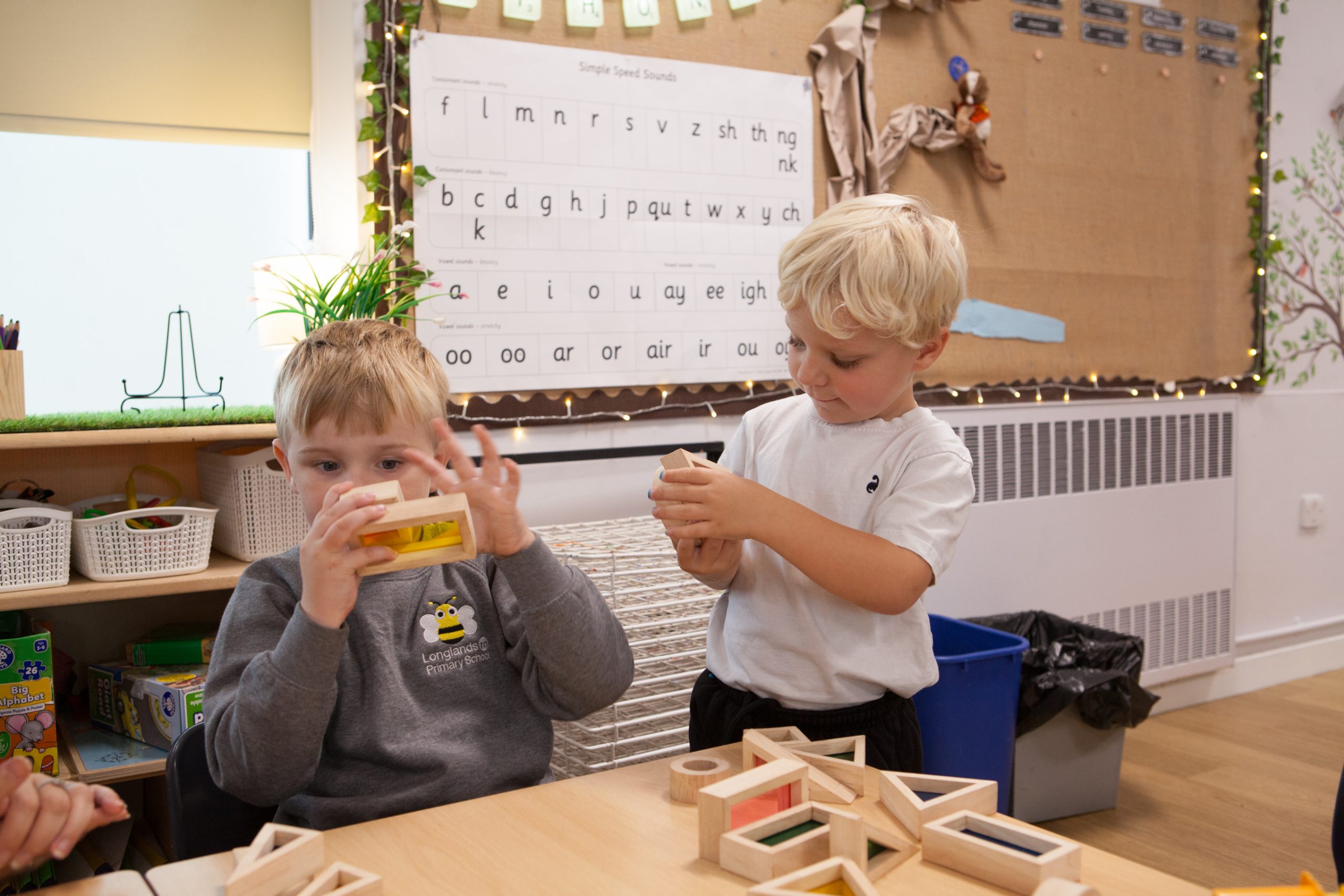
Learning is delivered through a balance of explicit teaching, guided practice, carefully planned continuous provision and responsive adult interaction. Adults model precise language, introduce and revisit vocabulary, scaffold learning, ask purposeful questions and help children apply new knowledge in their play.
- Read Write Inc. Phonics for systematic early reading.
- Pathways to Write to connect quality texts, talk, vocabulary and composition.
- Number Sense Maths to strengthen subitising, counting, comparison, composition and reasoning.
- A planned reading spine of stories, poems, rhymes and non-fiction.
- Purposeful indoor and outdoor continuous provision.
- Regular Forest School/Wild Woods, social farm and allotment learning.
- Healthy Movers, hall sessions and daily fine-motor development.
- Ongoing assessment that identifies what children know, what they need next and whether learning has been secured.
Impact
By the end of Reception, children are confident communicators, enthusiastic readers, developing writers, secure early mathematicians and curious learners. They can cooperate, persevere, manage increasingly complex routines and explain their thinking. They are prepared for the next stage of learning because important knowledge, vocabulary and skills have been deliberately taught, revisited and applied.
Our curriculum drivers
- Communication before content: Language is the foundation of learning.
- Reading at the heart: Stories, rhymes, songs and rich texts build vocabulary, knowledge and comprehension.
- Meaning before writing: Movement, talk, drawing and mark-making prepare children to communicate in writing.
- Depth before acceleration in mathematics: Children develop secure understanding of number rather than moving too quickly through content.
- Learning through relationships: High-quality interactions help children think, communicate and learn.
The EYFS Learning Journey