Speaking & Listening at Longlands Primary School
SPEAKING, LISTENING AND ORACY
Every child thinking. Every child talking. Every voice valued.
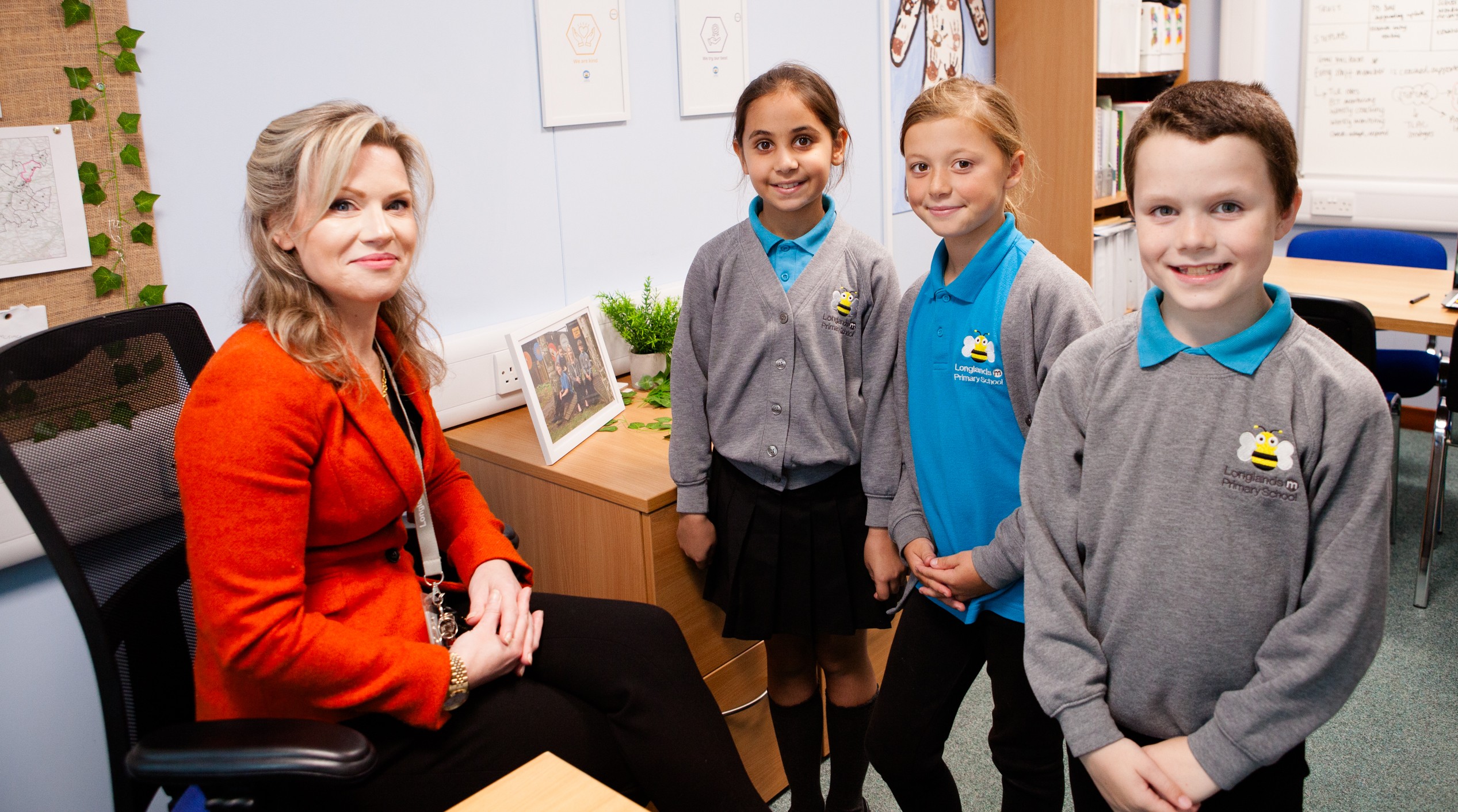
At Longlands, children do not simply learn to talk. They learn through talk.
Every child has a voice
At Longlands Primary School, speaking and listening are foundations for learning. We want every child to leave Longlands able to listen attentively, think carefully, speak clearly and confidently, explain understanding, ask thoughtful questions, discuss and challenge ideas respectfully, and adapt language for different audiences and purposes.
Oracy is not confined to English. It is deliberately developed from Nursery to Year 6 and across the whole curriculum.
Our intent
Our Speaking, Listening and Oracy curriculum ensures that every child learns to:
- listen attentively and respond appropriately
- express ideas clearly, confidently and in increasingly well-formed sentences
- acquire and use rich Tier 1, Tier 2 and Tier 3 vocabulary
- ask purposeful questions and clarify understanding
- explain, justify, reason, speculate and evaluate
- build on and respectfully challenge the ideas of others
- adapt language, register and tone for purpose and audience
- rehearse ideas orally before writing
- retell, recite, perform, present and debate
- participate confidently in collaborative learning
Our ambition is that no child’s participation in the curriculum is restricted by limited vocabulary, confidence or previous experience of high-quality talk.
Pupils who need additional support receive explicit modelling, visual support, vocabulary pre-teaching, sentence stems, additional processing time and repeated rehearsal, without reducing curricular ambition.
Implementation
It starts in EYFS: Communication and Language
Communication and Language is a prime area of learning in the statutory EYFS framework.
At Longlands, this begins a coherent journey:
Nursery 1: Explore; Nursery 2: Experience; Reception: Embed.
Children move from songs, stories, gestures, words and early phrases towards sustained conversation, explicit vocabulary, attentive listening and clear explanation in full sentences.
This follows our EYFS sequence: first-hand experience → explicit language → revisit and practise → apply with increasing independence.
Purposeful interaction throughout the day
Every interaction matters.
Adults listen carefully, comment, model and extend language, introduce vocabulary, rephrase sensitively, ask purposeful open questions, allow thinking time and sustain back-and-forth conversation. This is a Longlands curriculum expectation.
Real experiences give children something to talk about
Our social farm, Forest School and woodland, allotment, garden, outdoor learning, visitors, investigations, performances, role play, visits and trips give children knowledge and language to describe, explain, question, compare and remember. These first-hand experiences are deliberately connected to stories, vocabulary, sustained shared thinking and purposeful talk.
Talk Before You Write
THINK → TALK → REHEARSE → IMPROVE → WRITE → REFLECT
Speaking and listening are central to our writing curriculum. Before children write, they formulate, hear, test and improve ideas aloud.
Our consistent classroom sequence is:
Retrieve and Connect → Explain and Model → Talk and Rehearse → Guide and Check → Independent Release → Reflect and Respond.
During oral rehearsal, children say an idea or sentence, improve it and say it again before writing. Across the school, this develops from echo rehearsal, actions, images and sentence stems to paragraph rehearsal, debate, clause manipulation, vocabulary evaluation and deliberate choices about audience and purpose.
Talk in every lesson
Teachers deliberately structure talk so that every pupil thinks, rehearses and contributes. Our Teach Like a Champion strategies include:
| Strategy | How it supports oracy |
|---|---|
| Turn and Talk | all pupils rehearse an answer with a partner |
| Cold Call | all pupils remain ready to contribute |
| Wait Time | pupils have protected thinking time |
| No Opt Out | pupils are supported back into the discussion |
| Right is Right | spoken answers become accurate and complete |
| Stretch It | a correct response leads to deeper thinking |
| Format Matters | pupils use appropriate grammar and academic language |
| Call and Response / Choral Response | the class practises important language together |
These strategies form part of Longlands’ established Quality First Teaching expectations.
Vocabulary: words to think with
Vocabulary is a curriculum entitlement. Teachers identify the words pupils need, explain them in pupil-friendly language, model pronunciation and use, revisit them, connect them to morphology and etymology where appropriate, and expect pupils to apply them in talk and writing.
We teach: Tier 1 everyday vocabulary; Tier 2 high-value words used across contexts, such as compare, explain, justify and evaluate; and Tier 3 disciplinary vocabulary specific to a subject.
Progression from Nursery to Year 6
- EYFS: Attend, understand and communicate through responsive interaction, play, stories, songs, role play and first-hand experience.
- Key Stage 1: Speak audibly in complete sentences; listen and respond; retell, explain, clarify and rehearse sentences orally.
- Lower Key Stage 2: Organise explanations; justify opinions; use disciplinary language; build on and challenge ideas; present to an audience.
- Upper Key Stage 2: Sustain discussion and debate; support viewpoints with evidence; synthesise ideas; adapt register; present and advocate independently.
Poetry, performance and presentation
Children experience songs, nursery rhymes, storytelling, poetry, choral speaking, recitation and performance throughout school. Every term, classes have opportunities to present and talk about their learning in assembly. Children may explain a project, share writing, perform poetry, demonstrate learning or present an investigation to a real audience. [7]
One Voice
Through the Marches Academy Trust One Voice project, pupils develop an idea, discuss and refine it, prepare a message and pitch their ideas to an audience. This gives purposeful application to the progression: think → discuss → question → explain → persuade → present → respond.
Inclusion: every voice matters
Pupils with SEND, speech, language and communication needs or English as an additional language may need additional modelling, processing time, visual support, sentence stems, vocabulary pre-teaching or repeated rehearsal. Teachers adapt access and support while maintaining ambitious curriculum goals. Adults use scaffolds with a clear purpose and remove them as independence develops.
Impact
How we know children are progressing
Assessment is mainly formative and embedded in everyday teaching. Teachers listen during discussion, questioning, explanation, rehearsal and presentation; identify vocabulary or communication gaps; and adapt teaching. We look for increasing independence in attentive listening, clear articulation, use of taught vocabulary, reasoning, collaborative discussion, audience awareness and confident presentation.
Oracy begins with Communication and Language in EYFS and threads through every lesson, every subject and every interaction at Longlands.
Speaking & Listening at Longlands Primary School